
Hera captures a solar eclipse on Didymos; close-ups of Dimorphos due today
ESA’s Hera has recorded Dimorphos casting a shadow on Didymos. At 18:45 UTC today the agency is due to release the first close-up images of Dimorphos after the 2022 DART impact.
· 2 min read
In brief
- Hera recorded Dimorphos casting a solar eclipse shadow on Didymos.
- Close-up images of Dimorphos after DART are due at 18:45 UTC today.
- Hera will spend six months on the aftermath; CubeSats are due in January 2027.
The European Space Agency’s Hera spacecraft has recorded a solar eclipse in the Didymos–Dimorphos binary asteroid system. The smaller body, Dimorphos, passed between the Sun and the larger Didymos and threw a shadow across the bigger asteroid’s surface. The Sun lies off the right-hand edge of the frame. Today, Wednesday 25 November 2026, at 18:45 UTC, ESA is due to present the first close-up images of Dimorphos after NASA’s DART spacecraft struck it in 2022.
A shadow at 60 kilometres
Hera launched on 7 October 2024 and reached the pair earlier this month. On 5 November 2026 ESA reported a first glimpse of the target. In that early view Hera was about 60 kilometres from Didymos; Dimorphos appeared from the larger asteroid’s shadow.
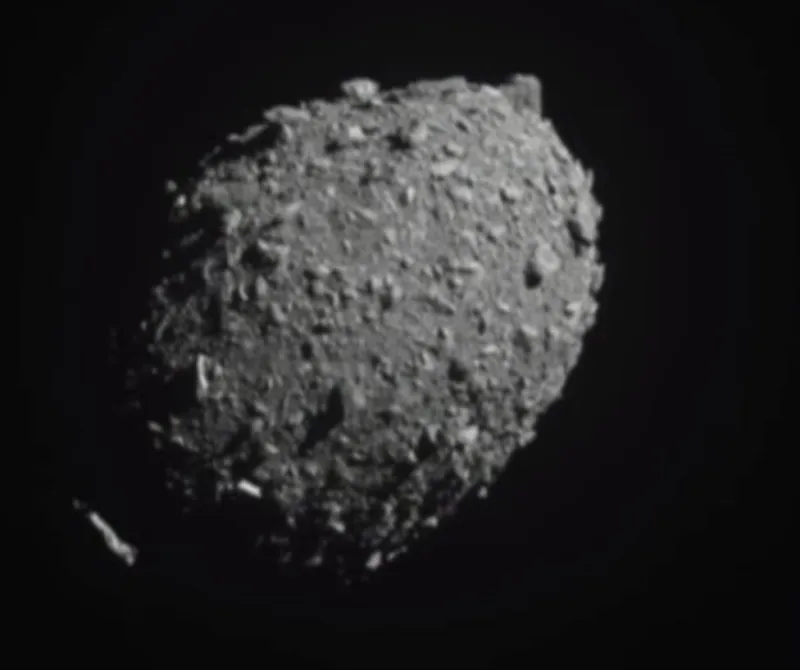
Principal investigator Patrick Michel said: “The first thing we said was wow! This is the other side of Didymos from the one that DART’s camera showed us shortly before impact, so this feels like looking at a whole new world.” The equatorial ridge seen before is still there, but the rest of this face looks different, with boulders, craters and what appear to be grooves or ridges. Material ejected when DART hit Dimorphos may have crossed the roughly 1 kilometre gap to Didymos, which could explain some of those features. The team expects to map both bodies and the changes in a systematic way.
Six months at the scene of DART
DART in 2022 was the first planetary-defence test to show that an asteroid’s path can be deliberately shifted. Hera is the follow-up: over six months it is to measure how the impact altered Dimorphos’s orbit and to study the structure of both asteroids and the debris thrown off by the strike.
In January 2027 Hera is scheduled to release two CubeSats. Milani would take spectral measurements of both surfaces; Juventas would use radar to sound the interior of Dimorphos — the first such sounding inside an asteroid.
What it means
The images due today, and the later radar and spectral work, should refine how well a kinetic impact can deflect an asteroid that might threaten Earth. The livestream offers the first detailed look at Dimorphos after DART; judging the orbital change and the interior remains the work of the months ahead.
- 60 km
- Hera’s distance from Didymos in the early image
- 1 km
- separation of Dimorphos and Didymos
- 18:45 UTC
- close-up image reveal today
- 6 months
- Hera’s survey of the binary system
Zivor poll
Will you watch ESA’s Hera livestream of the Dimorphos close-ups today?
Enjoyed it? Share it!
Sources
This article was produced with the help of artificial intelligence, based on the sources listed. How we work
Comments
Comments are reviewed by automated moderation every four hours; anyone can report unlawful content. Rules