
New flaring region on the Sun’s south-east limb; auroras possible this weekend
A new sunspot region rotating onto the Earth-facing disk produced six of nine B-class flares. No Earth-directed CME was seen; the geomagnetic field stayed quiet. Fast solar wind could still bring auroras this weekend.
· 2 min read
In brief
- Unnumbered south-east region produced six of nine B-class flares.
- No Earth-directed CME; Kp 0–2, below 1 by period’s end.
- 26–28 Nov: very low activity; C-class 15%, M and X 1% each.
- Fast solar wind could bring auroras this weekend.
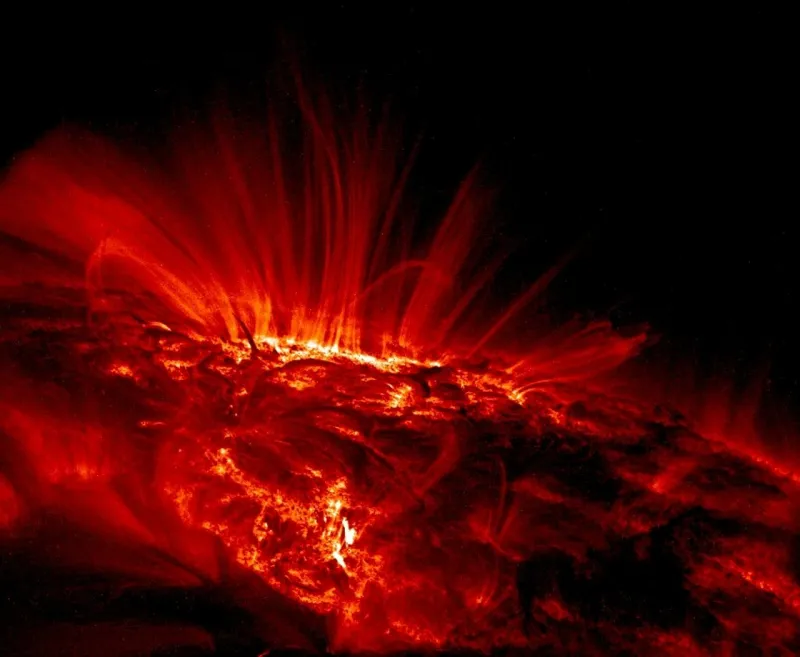
Over the past day, fiery jets and prominences along the Sun’s south-east limb marked a new sunspot region rotating into view. It has no official number yet, but it is already busy: it produced six of the day’s nine flares, including the strongest.
Overall flare activity remained very low. All nine events were B-class; there were no C-, M- or X-class flares, up from three flares the day before. Forecasters count three numbered regions on the Earth-facing disk; the south-eastern newcomer should receive a number as it rotates further onto the disk.
Solar wind, coupling and the outlook
No Earth-directed coronal mass ejections (CMEs) — clouds of plasma thrown from the corona — were observed in the past day. The solar wind began the period a little elevated, then eased after about 22 UTC on 25 November. The rise came as Earth passed through a corotating interaction region, a zone of compressed wind that often precedes a high-speed stream from a coronal hole.
The total interplanetary magnetic field stayed weak. The Bz component swung between north and south in the first half of the period, then turned south around 00 UTC on 26 November and remained there, allowing some weak coupling with Earth’s field. The geomagnetic field was quiet, with the Kp index (a 0–9 scale of disturbance) between 0 and 2, falling below 1 by the end of the period.
Forecasters expect very low activity on 26–28 November. They give C-class flares a 15 per cent chance today, and M- and X-class flares 1 per cent each. Fast solar wind could still bring auroras this holiday weekend, depending on the incoming stream and magnetic coupling.
What it means
At this very low flare level and with a quiet geomagnetic field, there is no basis for concern about radio, navigation or power-grid effects from the reported B-class events. Aurora at mid-latitudes would be unusual; if faster wind and a southward Bz combine, the display is more likely near the polar regions than over central Europe. Official space-weather alerts remain the guide; weekend outdoor plans need not change on this account.
- 9
- B-class flares in a day
- 6
- from the new region
- 15%
- chance of a C-class flare today
- 0–2
- Kp index
Zivor poll
Will you watch for aurora this weekend?
Enjoyed it? Share it!
Sources
This article was produced with the help of artificial intelligence, based on the sources listed. How we work
Comments
Comments are reviewed by automated moderation every four hours; anyone can report unlawful content. Rules