Hungary to extend river gauges at 29 sites after extreme drought
Hungary’s National Water Directorate is extending low-water gauges at 29 priority hydrological stations after prolonged drought left the lowest gauge plates above the water. The planned work is estimated at about 119.4 million forints.
· 3 min read
In brief
- OVF is extending low-water gauges at 29 priority hydrological stations after prolonged drought.
- Some form of technical work was identified at 72 stations nationwide.
- The estimated cost for the 29 priority sites is about 119.4 million forints; temporary measures keep monitoring continuous.
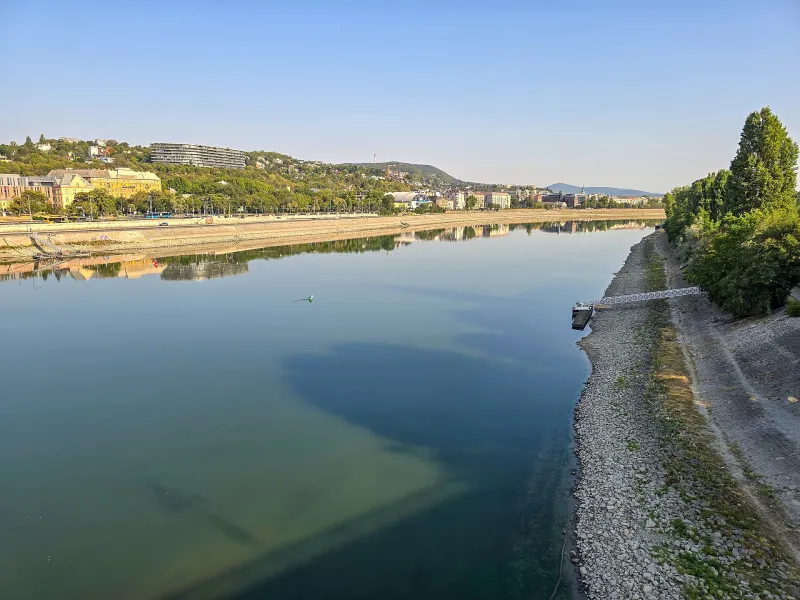
Prolonged drought has this year driven water levels on several Hungarian rivers so low that the bottom sections of staff gauges no longer reached the water. The National Water Directorate (OVF) has therefore begun extending low-water gauges and related works at 29 priority hydrological stations.
Work identified at 72 stations
OVF carried out a nationwide survey with the regional water directorates. The assessment found that some form of technical intervention is needed at 72 hydrological stations. Besides the Danube and the Tisza, sites on the Rába, Marcal, Dráva, Szamos, Hernád, Bodrog, Berettyó, Maros, Zagyva and Körös rivers are among those affected.
Extending an existing gauge is not enough everywhere. At some sites new gauge elements must be installed, water-level sensors moved deeper, recording equipment adapted, or the access steps to the gauge lengthened as well.
Danube and Tisza stations first
To use available funds responsibly and efficiently, OVF ranked the works in stages. Interventions began first at 29 priority stations on the Danube and Tisza systems, mainly where the data feed directly into water-level forecasts.
Twenty of these stations are on the Danube, including the areas of Komárom, Esztergom, Nagymaros, Vác, Budapest, Dunaújváros, Paks, Baja and Mohács. Eight are on the Tisza, around Záhony, Tiszadob, Tiszakeszi, Tiszadorogma, Kisköre, Tiszaroff, Szolnok and Martfű. One further station is on the Maros at Makó. Work at the 29 sites is still under way. On the final list of 29 stations, the combined estimated cost of the planned interventions is about 119.4 million forints.
Why continuous measurement matters in drought
Drought — persistently below-average precipitation combined with high evaporation — produces low flow in rivers, that is a prolonged spell of low water. If a gauge no longer reaches the channel, the hydrological record can break. That matters not only for daily information: water-level forecasts, navigation, irrigation and water-resource management all rely on these measurements.
OVF says the continuity of hydrological monitoring is ensured at all affected sites, independently of the completion of the final technical works. Where needed, temporary arrangements have been used so that water-level data continue to be collected even during low water.
What this means for readers
Along the Danube and Tisza — from Budapest to Baja, and from Záhony to Szolnok — navigation, water abstraction and local water management depend on an unbroken low-water record. Extending the gauges will not raise river levels, but it will allow persistently low stages to be followed reliably. Temporary measures already keep the data flowing until the permanent works are finished.
- 29
- priority stations in the first phase
- 72
- stations where work was identified
- 119.4 million HUF
- estimated cost for the 29 stations
- 20
- Danube stations in the first phase
Weather in the places mentioned
Zivor poll
What do you see as the main consequence of prolonged low water on rivers?
Enjoyed it? Share it!
Sources
- Meg kell hosszabbítani a vízmércéket a rekordalacsony vízállások miatt (24.hu)
- A rekordalacsony vízállás miatt meg kell hosszabbítani a vízmércéket (Telex)
This article was produced with the help of artificial intelligence, based on the sources listed. How we work
Comments
Comments are reviewed by automated moderation every four hours; anyone can report unlawful content. Rules