
Typhoon Bavi’s inner core: eyewall replacement, tilt, then a broader wind field
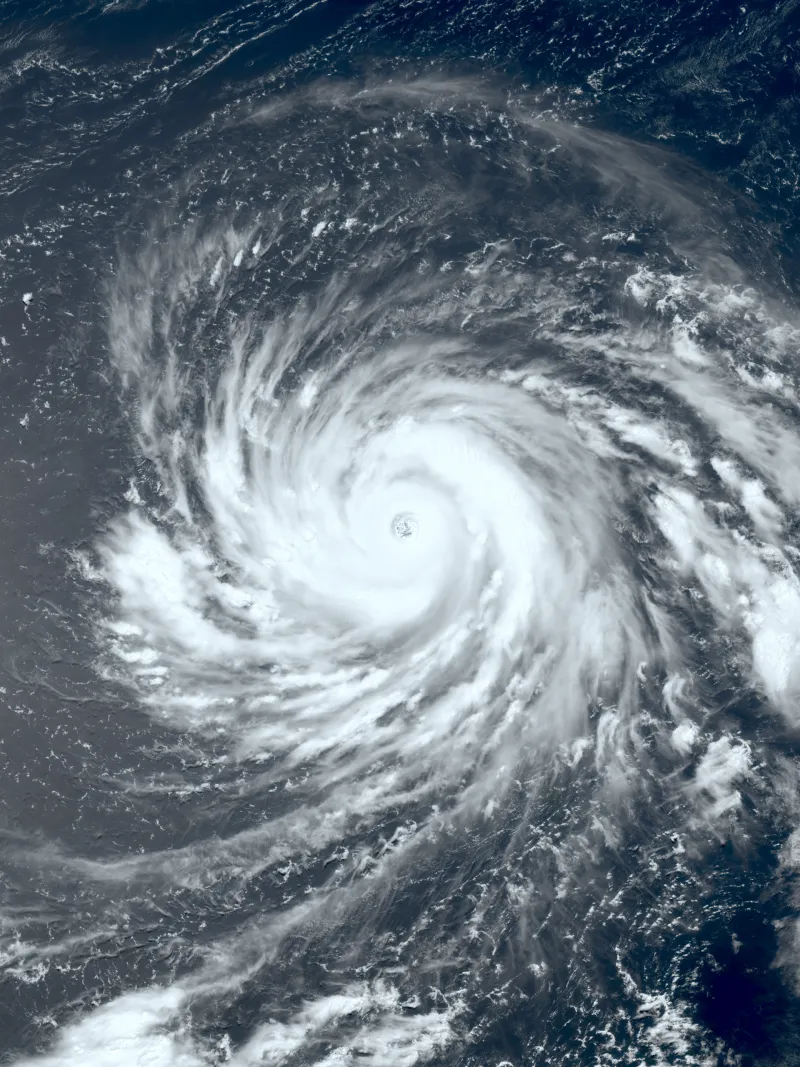
Researchers at the Institute of Oceanology of the Chinese Academy of Sciences reconstructed Typhoon Bavi’s full inner-core evolution by combining 17 spaceborne radar overpasses with geostationary satellite data.
· 3 min read
In brief
- IOCAS reconstructed Bavi’s inner core with 17 SAR overpasses and Himawari-9 data.
- Eyewall replacement ended around 23:00 UTC on 6 July; SAR–IR tilt reached 20.8 km.
- During weakening the RMW grew from 15–26 km to over 100 km, and beyond 200 km in some overpasses.
Tropical cyclones often reorganise rapidly in the inner core — the eye and the surrounding ring of deep convection known as the eyewall. Eyewall replacement, expansion of the wind field and vertical tilt all affect intensity and coastal hazard. A team at the Institute of Oceanology of the Chinese Academy of Sciences (IOCAS) reconstructed the full inner-core structural evolution of Typhoon Bavi by combining 17 repeated spaceborne synthetic-aperture radar (SAR) overpasses with geostationary infrared imagery and synthetic microwave brightness-temperature fields. The findings appeared in the Journal of Remote Sensing on 11 November.
A three-stage reorganisation
Near-surface ocean winds came from NOAA/STAR tropical-cyclone SAR products; cloud-top centres were taken from Japan Meteorological Agency Himawari-9 infrared observations. Deep convection and eyewall reorganisation were tracked with hourly synthetic 89 GHz microwave fields derived from multispectral infrared measurements.
A secondary eyewall formed and contracted inwards first. A pronounced horizontal offset then opened between the near-surface circulation centre and the upper-level cloud-top centre. Finally, during weakening, the region of strong winds expanded substantially.
Coordinated multisensor observations provide a rare vertical cross section of a typhoon’s life cycle.
First author Dr Mu Shanshan notes that pairing repeated high-resolution SAR wind snapshots with continuous geostationary infrared and synthetic microwave tracking pinpoints the timing of eyewall replacement, vertical vortex tilt and near-surface wind broadening.
Timing and distances
Between 00:00 UTC on 5 July and 6 July, the synthetic 89 GHz imagery captured the formation, intensification and inward contraction of the outer eyewall. The eyewall-replacement cycle concluded around 23:00 UTC on 6 July.
During the initial formation of the secondary eyewall, the SAR–IR tilt — the horizontal offset between the near-surface circulation centre and the infrared cloud-top centre — was relatively small, about 5–10 km. As replacement neared completion it widened to 17.8 km, and further to 20.8 km in observations on 7 July.
Radius of maximum wind grows
High-resolution SAR wind retrievals showed that as Bavi weakened later on, maximum near-surface wind speed declined overall while the radius of maximum wind (RMW, the distance from the centre at which the strongest winds occur) expanded dramatically. At peak intensity the RMW was tightly concentrated between 15 and 26 km. In later multi-scene observations it stretched beyond 100 km and exceeded 200 km in individual overpasses — a marked outward broadening of the gale-force wind swath.
Understanding when and how a typhoon’s wind field expands is just as critical for disaster preparedness as forecasting peak wind speed.
Corresponding author Dr Wang Chong presents the case as a benchmark for the physical coupling between eyewall-replacement cycles, cross-layer centre displacement and outer wind-field growth.
What this means
Coastal risk is set not only by peak wind but by how wide a belt of damaging winds becomes. Bavi shows that a weakening tropical cyclone’s inner core can tilt, with the RMW growing from a compact 15–26 km to more than 100 km, and beyond 200 km in some overpasses. Timing of eyewall replacement and wind-field expansion matters for storm surge and for wind damage across a broader coastal belt.
- 17
- SAR overpasses
- 20.8 km
- SAR–IR tilt
- 15–26 km
- RMW at peak
- >200 km
- RMW later, some overpasses
Zivor poll
For coastal risk, which lesson from Bavi matters most?
Enjoyed it? Share it!
Sources
- Researchers reveal inner-core structural evolution of Typhoon Bavi using multisensor satellite observations (Phys.org – Environment)
This article was produced with the help of artificial intelligence, based on the sources listed. How we work
Comments
Comments are reviewed by automated moderation every four hours; anyone can report unlawful content. Rules