
EarthCARE: rain helps break up marine clouds that shade the planet
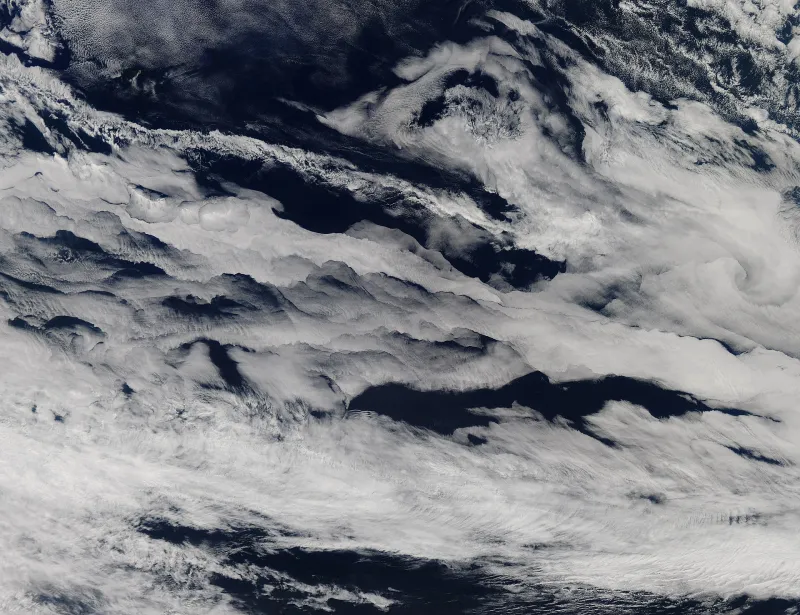
ESA’s EarthCARE satellite finds rain is a key driver of the shift from bright, closed-cell marine stratocumulus decks to fragmented open cells, exposing more dark ocean and reducing reflected sunlight.
· 3 min read
In brief
- EarthCARE profiles marine stratocumulus, droplets, rain and aerosols from space.
- Rain is identified as a key driver of the closed-to-open cell breakup.
- Falling rain washes out aerosols, remaining droplets grow, rainfall intensifies and the deck fragments.
- Less reflected sunlight means more energy stays in the climate system.
The European Space Agency’s EarthCARE satellite is already delivering new insight into how clouds help regulate Earth’s climate. The latest results highlight rain as a central process in the breakup of vast, bright cloud sheets that keep the planet cooler.
A natural sunshade over the oceans
Marine stratocumulus clouds, stretching across huge expanses of the world’s oceans, are among Earth’s most effective natural sunshades. These low, highly reflective, sheet-like decks bounce a substantial share of incoming sunlight back to space and help regulate global temperature.
When the decks break up, more of the dark ocean surface is left in the sun. The water absorbs far more solar energy, which adds a warming effect. Earth is reflecting less sunlight than it once did, so more energy stays in the climate system. That energy imbalance is larger than climate models have predicted.
Recent studies have found that marine stratocumulus clouds are in decline, which helps explain the drop in reflected sunlight. Why this is happening, and whether the trend will continue or accelerate as the planet warms, is still not fully understood. Profiling these clouds from space has been hard because they sit so close to the ocean surface.
Rain, aerosols and a self-reinforcing cycle
EarthCARE can probe the vertical structure of clouds and report on droplets, precipitation, fall speed and the aerosols involved in droplet formation. A paper in Atmospheric Chemistry and Physics shows how those observations are being used to study how marine stratocumulus evolve and break up.
Breakup does not mean the clouds vanish. A continuous, highly reflective closed-cell deck can reorganise into a more fragmented open-cell pattern, exposing much more dark ocean so that sunlight is absorbed rather than reflected.
Johanna Mayer, a research fellow at ESA’s Earth System Science Hub and lead author, said the team combined two views from space: a geostationary satellite, high above the equator and turning with Earth, to track how the clouds changed over time, and EarthCARE for snapshots of internal structure and precipitation.
“The observations point to rain as a key driver of cloud breakup from closed to open cells. They also provide further evidence of a self-reinforcing cycle predicted by theory.”
As clouds begin to rain, falling drops remove aerosol particles that normally provide surfaces for cloud droplets. With fewer particles, the remaining droplets grow larger, rainfall becomes more likely and the process intensifies. Eventually this feedback can disrupt the circulation that sustains a continuous deck, leaving distinctive open-cell patterns.
Bjorn Stevens, director of the Max Planck Institute for Meteorology, said that applying Mayer’s techniques to the growing EarthCARE record should improve understanding of the processes that govern Earth’s energy budget and, in turn, the rate of global warming.
What it means
These marine decks are not a local shower forecast. They are a large-scale control on Earth’s energy budget. If bright cloud sheets fragment more readily, more solar energy remains in the climate system. Agriculture, water resources and heat stress would feel that mainly through the pace of global warming, not through a single day’s weather.
There is no immediate travel, farming or health action that follows from this measurement for any one country. The practical point is scientific: linking droplet-scale processes to planetary climate should help forecast models represent how these sunshades may respond as the world continues to warm.
- EarthCARE
- ESA cloud satellite
- closed→open
- cell pattern shift
- ACP
- journal of the study
Zivor poll
What do the latest EarthCARE results identify as a key driver of marine stratocumulus breakup?
Enjoyed it? Share it!
Sources
- Satellite observations show how rain breaks up Earth's natural sunshades (Phys.org – Earth Sciences)
This article was produced with the help of artificial intelligence, based on the sources listed. How we work
Comments
Comments are reviewed by automated moderation every four hours; anyone can report unlawful content. Rules