High-emissions climate could more than double cloud-to-ground lightning
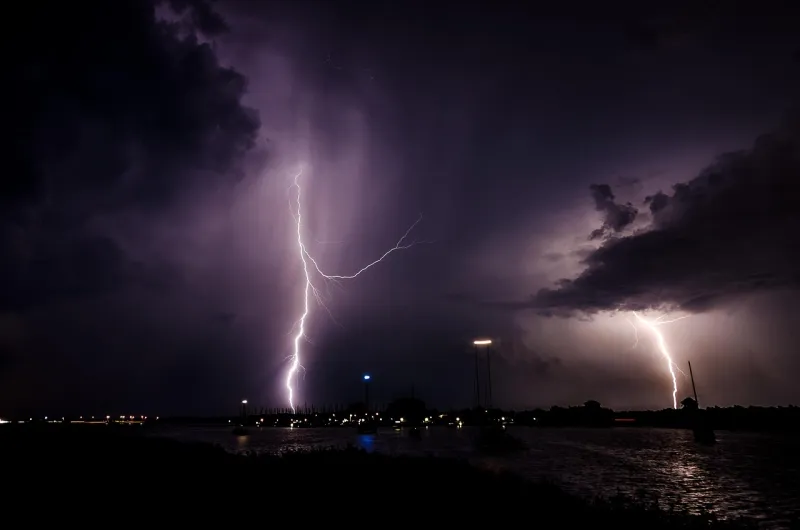
Under a high greenhouse-gas pathway, cloud-to-ground lightning may become 76–140% more frequent by the end of the century than in 1995–2014, according to a Technical University of Munich study in Earth’s Future.
· 3 min read
In brief
- Under high emissions, cloud-to-ground lightning may rise 76–140% by 2100 versus 1995–2014.
- The model found an 11% rise over the 20th century (~12%/°C); future sensitivity could reach ~30%/°C.
- Absolute increases are largest in the tropics; relative jumps are largest at high latitudes (Alaska 116–594%).
In a high-emissions future, cloud-to-ground lightning worldwide may become 76 to 140 per cent more common by the end of the century than it was between 1995 and 2014, according to research led by the Technical University of Munich and published in Earth’s Future. The projections apply to bolts that reach the ground: they start wildfires and can damage wind turbines, power lines, offshore oil rigs and other infrastructure. Such lightning kills several thousand people and hundreds of millions of trees each year.
Heat, ice and an unresolved tug of war
Lightning needs both warmth and cold. When near-surface air heats up it rises — convection — and stirs the colder atmosphere above. In the icy mid-levels of storm clouds, ice crystals collide and exchange charge; lighter and heavier particles then separate, building an electric field until a flash occurs.
As the climate warms, stronger convection can mean more lightning. That pattern is already familiar: strikes peak in the early afternoon heat and are more frequent in the tropics than at colder high latitudes. Warmer air could also leave fewer ice crystals aloft, making strong electric fields harder to form. Andreas Krause, an Earth-system scientist at the Technical University of Munich and the study’s lead author, said there is “quite a large uncertainty about how lightning will respond to climate change”, and that “it’s not quite clear which of these is more important”.
A steeper response per degree of warming
The team trained a machine-learning model on 2019 lightning and climate observations, including temperature, rainfall, humidity, air pressure, wind speed and incoming solar radiation. Applied to 1901–1920 and 1995–2014, it indicated an 11 per cent rise in cloud-to-ground lightning over the twentieth century — about 12 per cent for every degree Celsius of warming.
Under a high-emissions future corresponding to the SSP3-7.0 scenario, that relationship could become nearly three times as sensitive, about 30 per cent more lightning per degree of warming. Relative to 1995–2014, that would imply a 76–140 per cent increase by the century’s end, depending on the climate-model projections used. Earlier work put the highest estimates at 8–17 per cent per degree; the gap largely reflects different mathematical methods and a newer, more robust global lightning data set. Krause said he was surprised the projections were so high.
Tropics in numbers, high latitudes in relative terms
The model projected the largest rise in strike totals in the tropics, where lightning is already most common — especially the Amazon, South-east Asia and Oceania. Amazon projections carry the greatest uncertainty, because future climate there may differ sharply from the historical conditions used to train the model; some other studies even suggest less tropical lightning ahead.
The largest relative changes from the historical baseline may occur at higher latitudes, where lightning is now rare. Alaska, for instance, could see 116–594 per cent more ground-striking lightning than in the baseline period, when most of the state averaged fewer than one bolt per square kilometre per year.
What it could mean in practice
More cloud-to-ground flashes would raise the stakes for wildfire ignition, power and wind infrastructure, and people outdoors. During thunderstorms, a substantial building or a vehicle remains safer than open ground or sheltering under trees; farm and forestry work is best paused until the storm has passed. The study’s outlook is conditional on the high-emissions pathway and on the model’s assumptions.
- 76–140%
- possible global increase by late century
- 30%/°C
- sensitivity under high emissions
- 11%
- modelled 20th-century increase
- 116–594%
- relative increase in Alaska
Zivor poll
How do you think global lightning frequency will change by the end of the century?
Enjoyed it? Share it!
Sources
- Lightning could strike more than twice as often in a warming world (Phys.org – Environment)
This article was produced with the help of artificial intelligence, based on the sources listed. How we work
Comments
Comments are reviewed by automated moderation every four hours; anyone can report unlawful content. Rules