
Biela’s Comet breakup and November’s Andromedid meteor storms
The Andromedid meteor shower, which peaks in late November, is debris from Biela’s Comet, which split in the nineteenth century. It produced storms in 1872 and 1885; today’s meteors are too faint for the unaided eye.
· 2 min read
In brief
- Biela’s Comet split in 1846 and was not seen after 1852.
- The Andromedids produced storms on 27 November 1872 and 1885.
- The shower still peaks in late November but is too faint by eye.
- The meteoroid stream shares the comet’s orbit.
In 1772 the French astronomer Jacques Montaigne spotted a comet that was seen again in 1805 and 1826. That year the Austrian astronomer Wilhelm von Biela calculated a return every 6.6 years. The object came back on cue in 1832 and became known as Biela’s Comet.
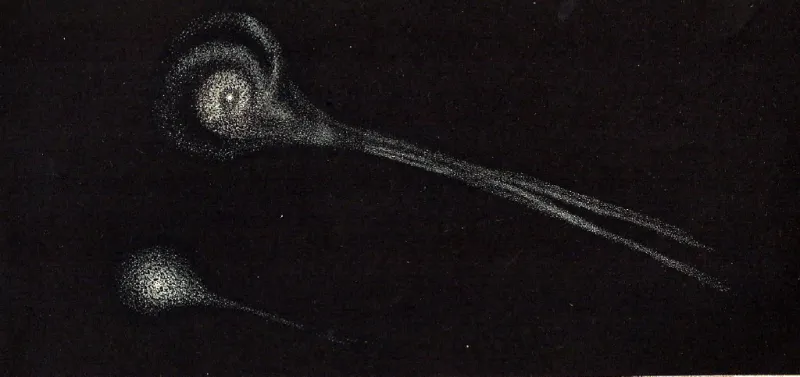
In 1846 it first appeared distinctly pear-shaped, then split in two some ten days later. The halves continued almost on the original orbit, one about 274,000 kilometres behind the other, with wildly fluctuating brightness. At the 1852 return the International Meteor Organization puts their separation at almost 1.6 million kilometres. Their orbits around the Sun had diverged slightly, one completing a circuit about 15 days before the other.
Two storms, thirteen years apart
The comet was not seen after 1852. In 1867 Edmond Weiss, Heinrich d’Arrest and Johann Galle independently matched the orbit of a known meteor shower — the Andromedids, first reported in 1741 — with that of Biela’s Comet, and realised Earth might cross the debris stream again in 1872.
They were right. On the evening of 27 November 1872, European astronomers watched meteors pour from the constellation Andromeda in numbers some estimates put at several thousand an hour. The encounter confirmed that comets can leave debris streams that produce meteor showers.
Thirteen years later, on 27 November 1885, Earth met another dense concentration. In Scotland, J. Smieton began counting at 5.30 p.m. at about 25 meteors a minute; by 6 p.m. the rate had climbed to 100 a minute. At Guildown, England, J. Rand Capron estimated 40 to 50 a minute at the busiest moments. He described the brightest as white, with long yellow or reddish-yellow trails; some appeared three or four times brighter than Jupiter. During the same display the Austrian astronomer Ladislaus Weinek captured what is generally considered the first successful photograph of a meteor.
An annual shower, now too faint to see
The Andromedids — sometimes called the Bielids — remain an annual shower, peaking around late November. Their radiant, the point from which the meteors appear to radiate, lies in Andromeda, the Chained Lady. The meteoroid stream shares the orbit of Biela’s Comet. Today the meteors are too dim for the unaided eye; the nineteenth-century storms marked dense remnants of the disrupted comet.
What it means for skywatchers
Late November, including around 29 November 2026, falls in the Andromedids’ annual peak, but the shower no longer offers a display visible without aid. The dense storms of thousands of meteors an hour belong to the historical record; nothing in the present stream suggests a repeat of 1872 or 1885 for casual observers.
- 6.6 years
- orbital period of Biela’s Comet
- 274,000 km
- separation of the two fragments in 1846
- 1872 and 1885
- dates of the Andromedid storms
- 100/min
- Smieton’s count at 6 p.m. in 1885
Zivor poll
Had you heard of the link between Biela’s Comet and the Andromedids?
Enjoyed it? Share it!
Sources
This article was produced with the help of artificial intelligence, based on the sources listed. How we work
Comments
Comments are reviewed by automated moderation every four hours; anyone can report unlawful content. Rules